Mechanical Design & System Integration

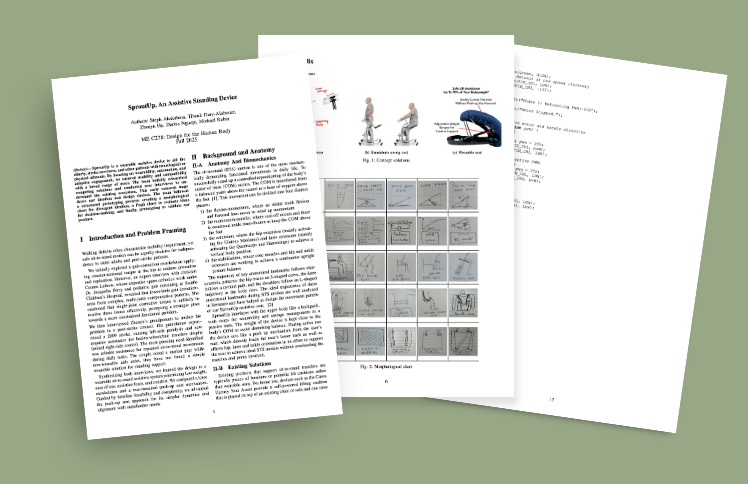
Sprout Up: Assistive Standing Device

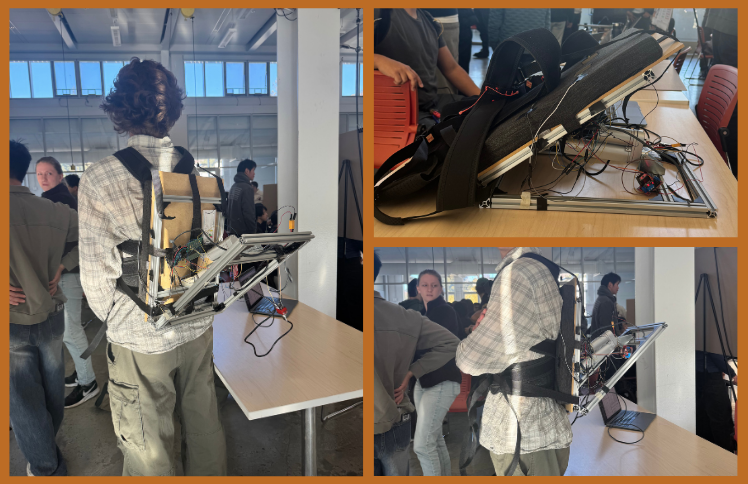
Designed and built a compact, assistive standing device to enable smooth, hands-free sit-to-stand transitions for users with limited lower-body strength. The system integrates mechanical actuation, kinematic modeling, and sensor-driven state control using lightweight, off-the-shelf components for affordability and manufacturability.


My Role

  • Mechanical design of the assistive seat and base frame using 2020 aluminum extrusion and wood platform, optimizing stiffness, footprint, and manufacturability from off-the-shelf components
  • Defined actuator placement, linkage geometry, and motion path to achieve smooth 4-second sit-to-stand trajectory (~25° to 75° seat angle)
  • Integrated sensor placement (force sensors on seat, IMU for angle feedback) and coordinated with electronics team on motor driver layout

Date:

Fall 2025

Course:

ME C278: Design for the Human Body

cover
cover
cover
cover

Additional information

Key Technical Achievements

  • Weight & Performance: Achieved 4 kg total system weight with 60% torque assistance (for an 80 kg torso).
  • Kinematics & Dynamics: Modeled seat kinematics using the law of cosines to map linear actuator motion to seat angle; derived Lagrangian dynamics with polynomial trajectory fitting (S-curve position profile) to determine required motor force (peak ~900 N stall, operating point ~150 N at 8–10 mm/s).
  • Compact Design: Minimum angle 35°, maximum 82° with a 200 mm linear actuator stroke; prototype cost approximately $400 using readily available components.
  • Autonomous State Machine: Integrated force-threshold triggering and IMU-based feedback to detect phase transitions (initialization → loading → extension → return-to-null) for hands-free operation.

Challenges & Solutions

  • High horizontal frame forces: Planned transition to welded joints and a curved frame design to lower the minimum seat angle and reduce actuator load.
  • Electronics integration complexity: Migrated from ESP32 (dependency and communication issues) to Arduino Uno R4 for simplified, robust microcontroller control.
  • Sensor robustness: Implemented force-sensing resistors (FSR) with voltage-divider readout and IMU-based angle feedback, with added noise filtering and debounce logic for reliable state detection.